Neighbourhood profile · Hibiscus and Bays local board
Maintaining a house in the East Coast Bays
The East Coast Bays are a string of beach suburbs facing the Hauraki Gulf, built mostly from the post-war decades onward on ridges of Waitematā sandstone and mudstone that weather to clay. Many homes sit on sloping sections or near eroding cliffs. The main upkeep pressures are ground movement and drainage on clay, salt-laden easterly wind, and an older stock of weatherboard and brick homes alongside 1990s and 2000s plaster houses that need careful moisture checks.
Profile checked · covers Castor Bay, Campbells Bay, Mairangi Bay, Murrays Bay, Rothesay Bay, Browns Bay, Torbay, Long Bay · Sources · Report an error
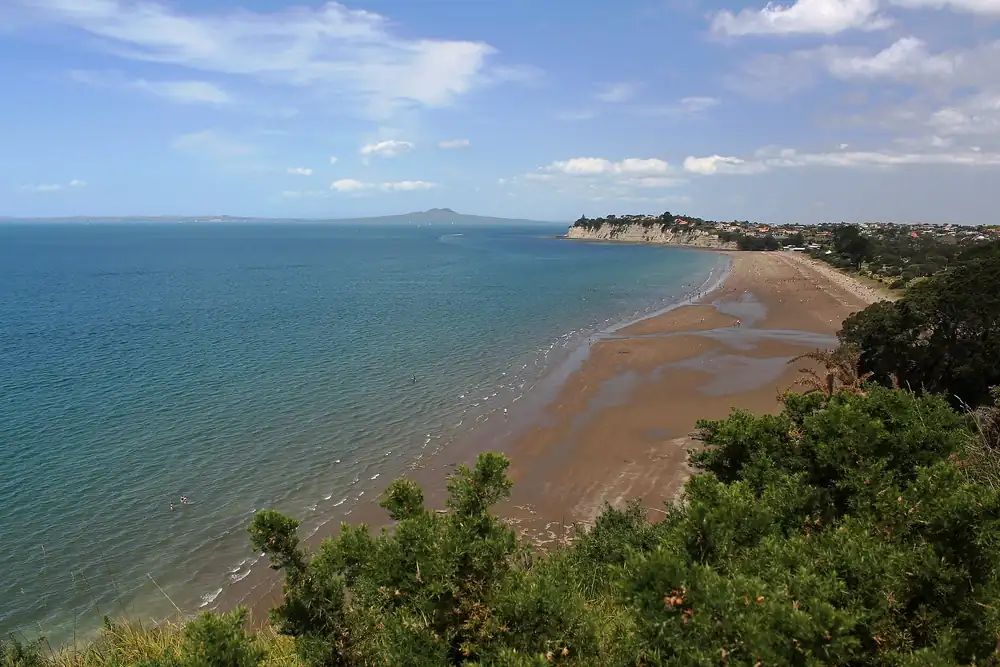
East Coast Bays at a glance
- Geology
- Layered Waitematā sandstone and mudstone, weathering to clay; coastal cliffs between the bays
- Housing
- Post-war weatherboard and brick, 1970s to 1990s family homes, 1990s to 2000s plaster, newer Long Bay subdivision
- Exposure
- Easterly and north-easterly wind straight off the gulf; salt on cliff-top and beachfront homes
- Hazards
- Coastal cliff instability mapped by the council; slips on steep clay sections after heavy rain
- Nearby reserves
- Long Bay Regional Park and the Long Bay-Ōkura Marine Reserve at the northern end
How close to the cliff edge is too close?
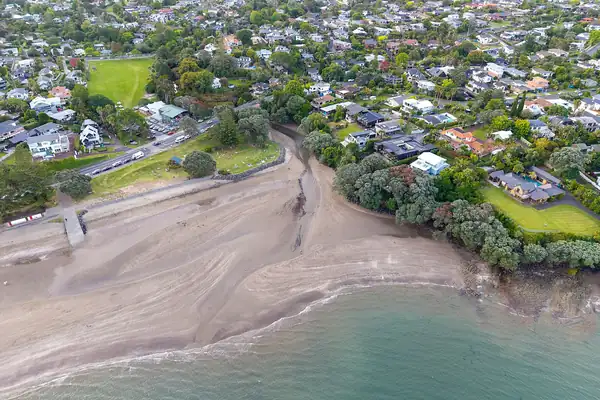
Along the East Coast Bays, some houses stand within metres of eroding sea cliffs, and research on this coast has mapped hazard zones extending well inland from the cliff line. A homeowner on a cliff-top section should know where council coastal instability and erosion mapping places their land, keep stormwater away from the edge, and avoid heavy landscaping, decks or retaining near it without engineering advice.
Auckland Council has modelled the region's exposure to coastal instability and erosion, and its own report notes that distances vary with geological type, exposure and cliff height. The sandstone and mudstone here erode slowly in most years but can drop sections suddenly after storms.
Pōhutukawa along the cliffs help hold the edge but also put roots into drains and paths. Removing or heavily trimming them near the edge is a job for an arborist who knows the council's tree rules.
Clay soil, drainage and the slow-moving section
The sandstone and mudstone under the bays weathers into clay that swells when wet and shrinks in dry summers. That movement shows up as sticking doors, cracked paths, leaning retaining walls and blocked or broken stormwater pipes. Keeping gutters, downpipes and soak points working is the cheapest defence, because clay that stays saturated is the clay most likely to slip.
Many sections in Mairangi Bay, Murrays Bay and Torbay are stepped into slopes with timber or block retaining walls, some decades old. Timber walls rot at the base and lean slowly; a lean that gets worse each winter is a sign to call an engineer rather than a handyman.
- Clear gutters before winter, since overflow saturates the ground beside foundations
- Check that downpipes discharge into the stormwater system, not onto a bank
- Watch for new cracks in paths and pavers after a dry summer
Plaster homes from the 1990s and 2000s
The bays gained a large number of plaster-clad homes in the 1990s and early 2000s, the period of New Zealand's weathertightness failures. Monolithic cladding fixed directly to framing without a drained cavity is listed by MBIE determinations as a weathertightness risk factor. Owners and buyers of these houses benefit from regular checks of sealant, flashings and the bottoms of walls, and a specialist moisture survey before purchase.
Washing plaster gently once a year also lets the owner see hairline cracks and failed sealant around windows. Repainting should only follow repairs, because fresh paint can hide cracks that let water in.
The gulf wind and what it does to roofs
Homes on the ridges above Browns Bay and Torbay catch the full force of easterly storms, and that is when roofs lose fixings, ridge caps and flashings. Salt carried on the wind dulls paint on roofs and coats windows. An inspection after a big easterly, and a roof wash and repaint on the schedule the coating calls for, keep a coastal roof watertight.
Lichen and moss grow on the more sheltered, south-facing roof planes even here, and treating them before repainting helps coatings bond.
Bush gullies, pests and Long Bay
Many streets back onto bush-filled gullies and reserves running down to the bays, and those strips carry rats, possums and nesting wasps into gardens. Long Bay, at the northern end, borders a regional park and a marine reserve, so homes there sit near large areas of open space. Gully-edge properties tend to need more rodent proofing and checks for wasp nests in late summer.
German and common wasps often nest in banks and retaining walls on these slopes. Nests in the ground are easy to disturb with a mower or line trimmer, so care is needed in late summer when nests are largest.
Long Bay's newer homes are built to modern standards but sit on recently formed earthworks, where settling of fill, drainage and landscaping can still need attention in the first years.
Hiring trades along the bays
Access is generally easier here than in older inner suburbs: most homes have driveways and off-street parking. The harder jobs are on steep sections, where scaffolding, ladders and materials have to go down or up a slope, and on cliff-top sites where machinery cannot get close to the edge. Telling a contractor about the slope when booking saves a second visit.
East Coast Road and the Northern Motorway link the bays to the rest of the North Shore, and many trades based in Albany or Glenfield cover the area.
Ranked businesses that reach East Coast Bays
East Coast Bays sits inside the guide's North Shore area, which has its own ranked lists for pest control, wasp nest removal, house washing, gutter cleaning, roof painting and garage door repair. The table counts, for every trade, the eligible businesses whose Google listing is in one of the localities above or whose own website names one of them.
| Trade | Listing here | Website names it | Eligible Auckland-wide |
|---|---|---|---|
| Pest control | 1 | 5 | 41 |
| Borer treatment | 0 | 0 | 19 |
| Wasp nest removal | 1 | 2 | 35 |
| Commercial pest control | 0 | 2 | 32 |
| House washing | 0 | 5 | 46 |
| Gutter cleaning | 1 | 7 | 43 |
| Roof painting | 2 | 4 | 40 |
| Handyman services | 0 | 3 | 18 |
| Healthy homes assessments | 1 | 1 | 10 |
| Garage door repair | 0 | 2 | 29 |
Counts come from the guide's Google Maps and website data (read 6 October 2026; garage doors 10 October 2026). A business that serves all of Auckland without naming suburbs is not counted here, so a low number does not mean nobody comes.
Prices, from businesses' own published lists: pest control · borer treatment · wasp nest removal · house washing · gutter cleaning · roof painting · handyman services · healthy homes assessment · garage door repair.
Questions owners ask about East Coast Bays
How do I find out if my property is in a coastal hazard area?
Auckland Council publishes coastal instability and erosion mapping, and the council's GeoMaps viewer shows hazard layers for individual properties. A LIM report also records known hazards. For cliff-top sections, a geotechnical engineer can interpret the mapping for the specific site before building, retaining or landscaping near the edge.
Are plaster houses in the East Coast Bays leaky?
Not all of them. Risk depends on design, cladding system, whether there is a drained cavity, and how well the house has been maintained. Many plaster homes perform well. A specialist building surveyor using moisture meters and, where needed, invasive testing is the reliable way to know, especially before buying.
Why do my doors stick in summer and winter?
Clay soils move with moisture. As the ground swells in winter and shrinks in a dry summer, foundations shift slightly and door frames go out of square. Keeping water draining away from the house reduces the movement, and a builder can ease doors once the cause is understood.
Sources
- Auckland Council (OurAuckland): Prediction and planning, coastal erosion in Tāmaki Makaurau
- Auckland Council: Predicting Auckland's exposure to coastal instability and erosion (technical report)
- University of Auckland: East Coast Bays geology
- Natural Hazards journal: coastal cliff hazard zonation, East Coast Bays
- MBIE building.govt.nz: Determination 2005/56 (monolithic cladding weathertightness risk)
Nearby profiles: Hibiscus Coast · Albany · all neighbourhoods.